


Pulmonary Function Test: What Does It Actually Tell You About Your Lungs?
Fast Facts
- Pulmonary Function Tests (PFT) measure the effectiveness of your lungs.
- It tells you how fast and how much air you breathe in and out.
- Diagnoses problems including asthma, COPD and other lung diseases.
- The test is easy, painless and in most cases non-invasive.
- Your doctor may recommend it if you have a persistent cough, wheezing or breathlessness.
Introduction
Shortness of breath, wheezing or a cough that won’t go away can have many causes. Pulmonary Function Test (PFT) helps your doctor to know what is going on with your lungs.
It measures how much air your lungs can hold , how quickly you can breathe it out , and , with some tests , how well your lungs transfer oxygen .
What Does a PFT Tell You?
How much air your lungs can take in. It’s a test that measures your lung capacity and can show if your lungs are holding less air than they should.
Quality of Air Movement
It tells you how many miles an hour you can blow air out. Conditions like asthma or COPD can cause reduced air flow.
Are Airways Constricted
Your doctor might have you do the test again after a bronchodilator to see if your airflow improves.
How Your Lungs Exchange Oxygen
Some PFTs measure how well oxygen travels from your lungs into your blood.
When Should You Get a PFT?
Your doctor may suggest one if you have any of the following:
- Ongoing cough
- Breathing difficulty
- Wheezing
- Tightness in chest
- Exercise intolerance decreased
- Lung condition known to follow
What does the test consist of?
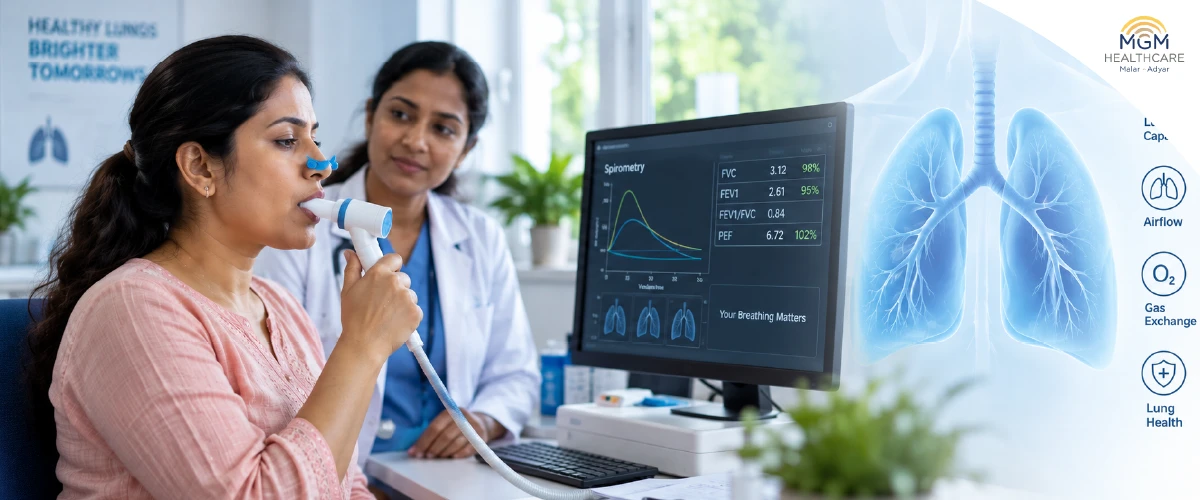
You blow in a machine called a spirometer. You may be asked to breathe in deeply and then exhale as hard and fast as possible.
The test may be repeated several times to obtain accurate results.
Does it hurt?
No. PFTs are usually painless and non-invasive.
Repeated forceful breathing may cause brief dizziness or light-headedness. If this is the case, tell the technician.
What do the results tell us?
Your doctor considers the results along with your symptoms, medical history and other tests.
An abnormal result does not necessarily mean you have a lung disease. Additional evaluation may be needed.
When to See a Doctor
Call your health care provider if you have:
- A persistent cough or wheezing
- Persistent breathlessness
- Tightness in the chest
- Problems with usual physical activity
- Recurrent respiratory symptoms
Expert Insights:
A PFT can be useful in learning how well your lungs move air and, in some cases, how well they exchange gasses. It is an important part of assessing lung health and should be considered along with your symptoms and medical history.
Key points
PFTs measure how well your lungs are working.
- They measure lung capacity and airflow.
- Some tests also examine the exchange of gas.
- PFTs are useful in diagnosing and monitoring different lung diseases.
- Never ignore breathing problems that persist.
About the Reviewer
Schedule Your Appointment
Do not ignore a persistent cough, wheezing or breathlessness.
MGM Healthcare specialists can evaluate your symptoms, advise the best tests and guide you to the most appropriate care.
Call us to make an appointment.
Frequently Asked Questions
It measures how much air your lungs can hold , how fast you can blow it out and sometimes how well your lungs transfer gasses.
No. It is usually painless and non-invasive.
It can provide valuable information in the evaluation of asthma. Your doctor may also check how you breathe before and after using a bronchodilator.
PFTs, particularly spirometry, assist in identifying the airflow obstruction seen in COPD.
It is contingent upon the tests done but often a session is 30-60 minutes.
Contact Us
Appointments
Emergency
MGM - Malar Adyar
Old No. 52 New No. 111, 1 st Main Road, Gandhi Nagar, Adyar, Chennai – 600020


At MGM Malar - Adyar Hospital, our philosophy centers on alleviating the apprehension associated with illness. Recognizing that confronting health challenges entails both physical and emotional struggles, our devoted team is steadfast in delivering outstanding healthcare to enhance your overall wellness and alleviate the stress that accompanies medical conditions. Situated in the heart of the city with a 141-bed facility, we are dedicated to supporting you throughout your healthcare journey.
© 2026 MGM Malar - Adyar. All Rights Reserved.